
Bringing solutions to Europe's Energy Storage challenge
Unlike conventional energy storage, LDES can hold large amounts of electricity over many hours or even days so that power is available exactly when it's needed. As Europe's energy system comes to rely more heavily on renewable sources such as wind and solar, this kind of flexibility is what allows the grid to stay reliable even when the sun isn't shining or the wind isn't blowing.
AVANGUARD's overarching objective is to accelerate the penetration of Long Duration Energy Storage in the EU energy system.
AVANGUARD will develop a free, open-source tool suite and data hub to deepen understanding of Long Duration Energy Storage (LDES), equipping energy stakeholders with the tools to assess LDES’ viability and its role in grid reliability.
Once the platform is ready, a dedicated training campaign will introduce it to LDES stakeholders – such as grid operators, technology providers and policymakers - helping them put it to work.
At the same time, AVANGUARD will contribute directly to future EU policy development, accelerating the adoption of LDES technologies across the continent.
AVANGUARD at a glance
Project budget
€6.998M
13 countries
29 partners
Coordinator
DTU
June 2026 - May 2030
48 months
Programme
Horizon Europe
Grant Agreement
101269474
Why AVANGUARD
The project addresses current limits on LDES technologies:
No open, end-to-end modelling of LDES value across planning, networks and market participation
No dedicated LDES Data Hub. The system needs a single, harmonised source of data ready for full end-to-end modelling and analysis
Limited real-world testing. LDES technologies and tools need far more validation in live, operational settings
Persistent bottlenecks are slowing the understanding and deployment of LDES
No transparent, replicable way to assess LDES's full value. End-to-end evidence from real-world Use Cases still missing.
Our Work
A secure, shared Data Hub for LDES
A central, interoperable repository for energy storage, grid and market data, so that every AVANGUARD tool draws on the same reliable information.
An open-source tool suite
Free tools to plan and optimise LDES deployment across different technologies, networks and markets
Pan-EU validation
Testing these tools under real conditions across Europe, to prove the value LDES can bring in different regions.
Business models and regulatory frameworks
Practical guidance to help LDES technologies move from pilot projects to widespread adoption.
Train & scale
A dedicated training programme introduces EU stakeholders to the platform, supporting adoption well beyond the project's lifetime.
Awareness and dissemination
Raising awareness of LDES and promoting AVANGUARD's tools to the people who can put them to work.
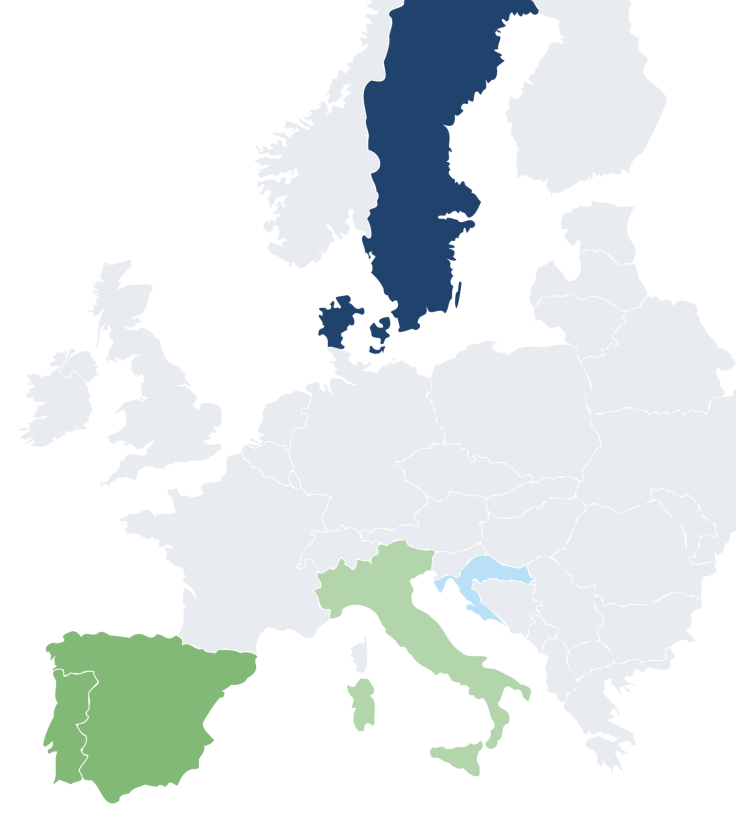
Four Use Cases across Europe
AVANGUARD's approach will be tested and proven through an international validation campaign spanning four cross-regional Use Cases, each involving local grid operators and real operating conditions.
Spain & Portugal
Distribution network digitalisation and storage integration
Croatia
National grid resilience and storage planning
Italy
Multi-utility storage deployment at scale
Denmark & Sweden
Cross-border grid flexibility and storage dispatch
LDES technologies
AVANGUARD's Use Cases and open-source tools are designed to work across the full range of LDES technologies, reflecting the diversity of solutions being developed and deployed across the sector.
AVANGUARD's own validation campaign will test a representative cross-section of these technologies, thanks to the presence of LDES technology manufacturers within the consortium.
Thermal storage
Converts electricity into heat, stored in low-cost materials such as molten salt, bricks or rocks, and released later as heat, cooling or electricity. Thermal storage is particularly well suited to industrial decarbonisation, where it can displace fossil-fuel heat generation.
Electrochemical storage
Covers a wide range of battery chemistries, including flow, metal-air, zinc, sodium and lithium-ion batteries. These technologies allow to store energy through a reversible chemical reaction and can operate over longer durations than conventional batteries.
Mechanical storage
Uses water, air or gravity, together with turbines, compressors and other machinery, to store and release energy. Pumped hydro storage is the most established example, alongside newer approaches such as compressed air, liquid air and gravity-based storage.
Chemical storage
Converts electricity into energy-carrying chemicals such as hydrogen, which can be stored and later reconverted into power, or used directly in industrial and transport applications.
Consortium
AVANGUARD brings together 29 organisations from 13 countries, spanning academia, industry and policymaking. The AVANGUARD consortium includes LDES sector's key stakeholder groups:
Together we unlock Europe’s LDES future

This project has received funding from the European Union's Horizon Europe research and innovation programme under grant agreement N. 101269474. Views and opinions expressed are however those of the author(s) only and do not necessarily reflect those of the European Commission or CINEA, the granting authority. Neither the European Commission nor the granting authority can be held responsible for them.